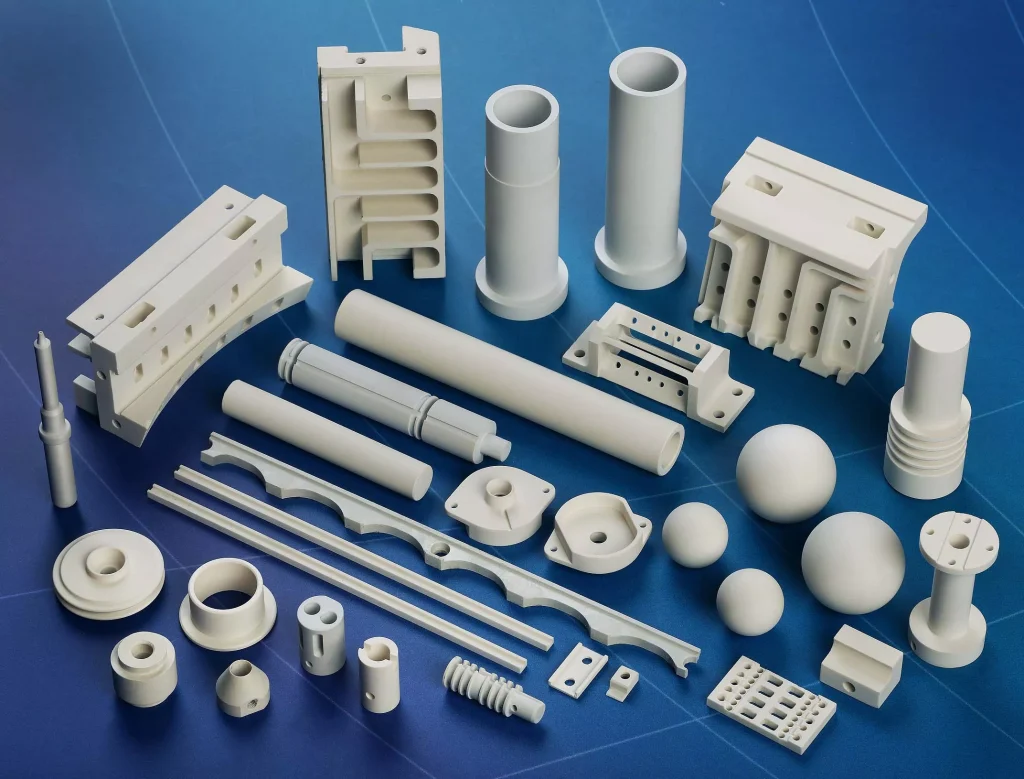
Aluminum oxide (Al₂O₃) ceramics have high hardness, strength, and excellent wear and corrosion resistance, and are widely used in the manufacture of high-precision components such as electronic insulation, mechanical wear parts, and medical equipment. Its insulating properties and high temperature resistance (up to 1500°C) make it an ideal processing material for stable performance in high-temperature environments such as electronics, chemicals and aerospace.
| Model |
Density (g/cm³) |
Hardness (HV) |
Tensile Strength (MPa) |
Fracture Toughness (MPa-m^0.5) |
Heat Resistance (°C) |
| 96% Alumina | ~3.7 | 1500 | 300 | 3.0 | 1600 |
| 99% Alumina | ~3.9 | 1700 | 350 | 3.5 | 1700 |
| 99.5% Alumina | ~3.9 | 1800 | 370 | 4.0 | 1750 |
| High Purity Alumina (99.9%) | ~3.95 | 1900 | 400 | 4.5 | 1800 |
| Porous Alumina | ~3.5 | 1200 | 250 | 2.5 | 1400 |
Zirconia (ZrO₂) ceramics are widely used in CNC machining for their high toughness, hardness and wear resistance. Its superior strength and crack resistance compared to aluminum oxide makes it suitable for precision parts where high impact and wear resistance is required. Its corrosion resistance and chemical stability make it useful in medical, automotive and aerospace applications for cutting tools, seals, dental materials and more. In addition, zirconia’s excellent thermal insulation properties make it suitable for high-temperature environments.
| Model |
Content (%) |
Density (g/cm³) |
Hardness (HV) |
Flexural Strength (MPa) |
Toughness (MPa-m^1/2) |
Thermal Conductivity (W/m-K) |
Max Working Temp (°C) |
| Y-TZP | ZrO₂ ≥ 94% | 6.0–6.1 | 1200 | 900–1200 | 8–10 | 2.5 | 1000 |
| Mg-PSZ | ZrO₂ ≥ 94%, MgO 4–5% | 5.7 | 1100 | 800–1000 | 6–8 | 2.5 | 1100 |
| Ce-TZP | ZrO₂ ≥ 90%, CeO₂ 10% | 6.1 | 1200 | 600–800 | 10–12 | 2.6 | 1000 |
Silicon Carbide (SiC) ceramics are widely used in CNC machining due to their excellent resistance to high temperatures, corrosion, and high hardness. They are particularly suitable for the manufacture of mechanical seals, semiconductor equipment parts, and wear-resistant components, and are widely used in aerospace and chemical applications. Its good thermal conductivity makes it stable in extreme environments and suitable for applications requiring high strength and durability.
| Model |
Content (%) |
Density (g/cm³) |
Hardness (HV) |
Flexural Strength (MPa) |
Thermal Conductivity (W/m-K) |
Max Working Temp (°C) |
| RBSC | SiC ≥ 85% | 3.1–3.2 | 2200 | 300–400 | 90–100 | 1350 |
| SSiC | SiC ≥ 98% | 3.1 | 2500 | 400–500 | 120–130 | 1600 |
| HPSiC | SiC ≥ 99% | 3.1–3.2 | 2700 | 500–600 | 130–140 | 1800 |
 English
 Français
 Deutsch
 Italiano
 Português
 Español
 العربية