
Precision Casting Services

Precision casting, compared to die casting, has the advantages of low mold costs, complex shapes, tight tolerances, smooth surfaces, less machining, and material savings, providing the most cost-effective precision casting service for mass production of custom precision casting parts.

Get a Rapid Quote
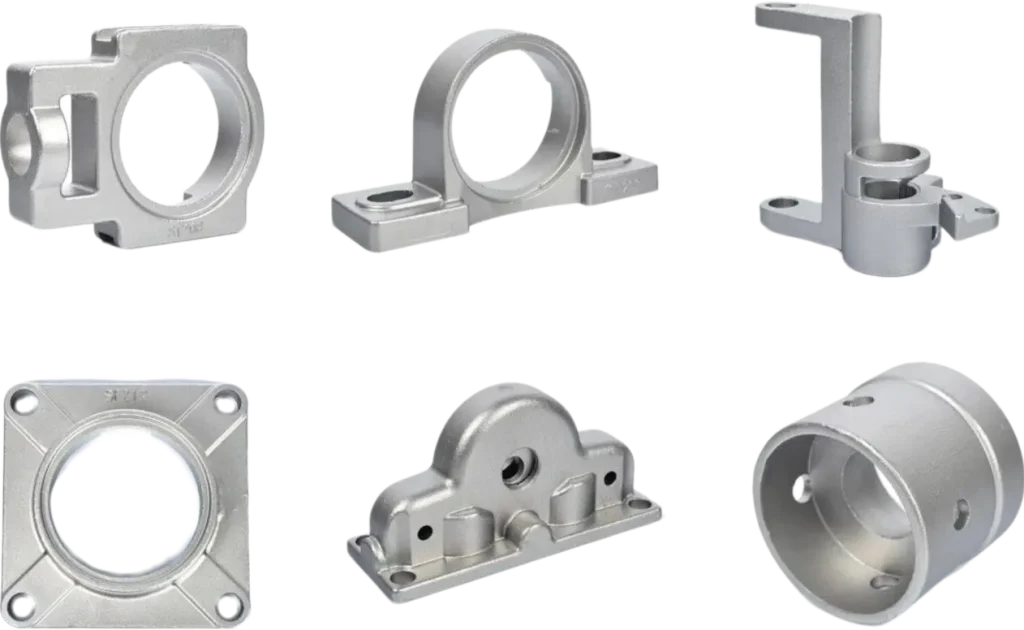
Precision Casting
Precision Casting

What is Precision Casting?


Precision casting, also known as investment casting or lost wax casting, begins with the creation of a precise wax mold that replicates the required final parts. The wax mold is then coated with a fine ceramic material to form a shell, which is heated to harden the ceramic shell and melt the wax mold, leaving a hollow ceramic mold. The mold is preheated to ensure that the molten metal (usually steel, aluminum or titanium) flows smoothly into the cavity. After the metal has been poured and solidified, the ceramic shell is cracked and the casting is finished. This process ensures excellent detail and dimensional accuracy, making it ideal for manufacturing complex parts with intricate features and tight tolerances, while also significantly saves materials and reduces machining.

Advantages of Precision Casting

EDM and Wire EDM offer unique benefits for high precision, intricate designs, and tough materials. Top six advantages:

High Dimensional Accuracy

Precision casting delivers components with tight tolerances and excellent dimensional consistency, often eliminating the need for extensive machining. This makes it ideal for parts requiring high precision, such as turbine blades, surgical tools, or complex gear components.

Complex Geometries

The casting process allows the formation of intricate shapes, thin walls, and internal cavities that would be difficult or impossible to achieve with machining or forging. This enables engineers to design freely without being constrained by manufacturing limitations.

Material Versatility

Precision casting supports a wide range of metals and alloys—including stainless steel, carbon steel, aluminum, titanium, and superalloys—making it suitable for applications with specific mechanical, thermal, or chemical requirements.

Excellent Surface Finish

With fine-grain ceramic molds and advanced process control, precision-cast parts feature smooth surfaces that reduce the need for post-processing. This is especially beneficial for aesthetic or aerodynamic parts where surface quality is critical.

Reduced Material Waste

By forming near-net-shape components, precision casting minimizes material removal during finishing and decreases raw material waste. This not only cuts costs but also improves sustainability across the manufacturing cycle.

Cost-effective

Unlike forging or stamping, precision casting doesn't require expensive tooling for each geometry. It offers cost advantages for low and medium production runs of complex parts, making it ideal for prototyping and specialized industries like aerospace and medical.

Order Your Custom Parts Today

Get a Rapid Quote