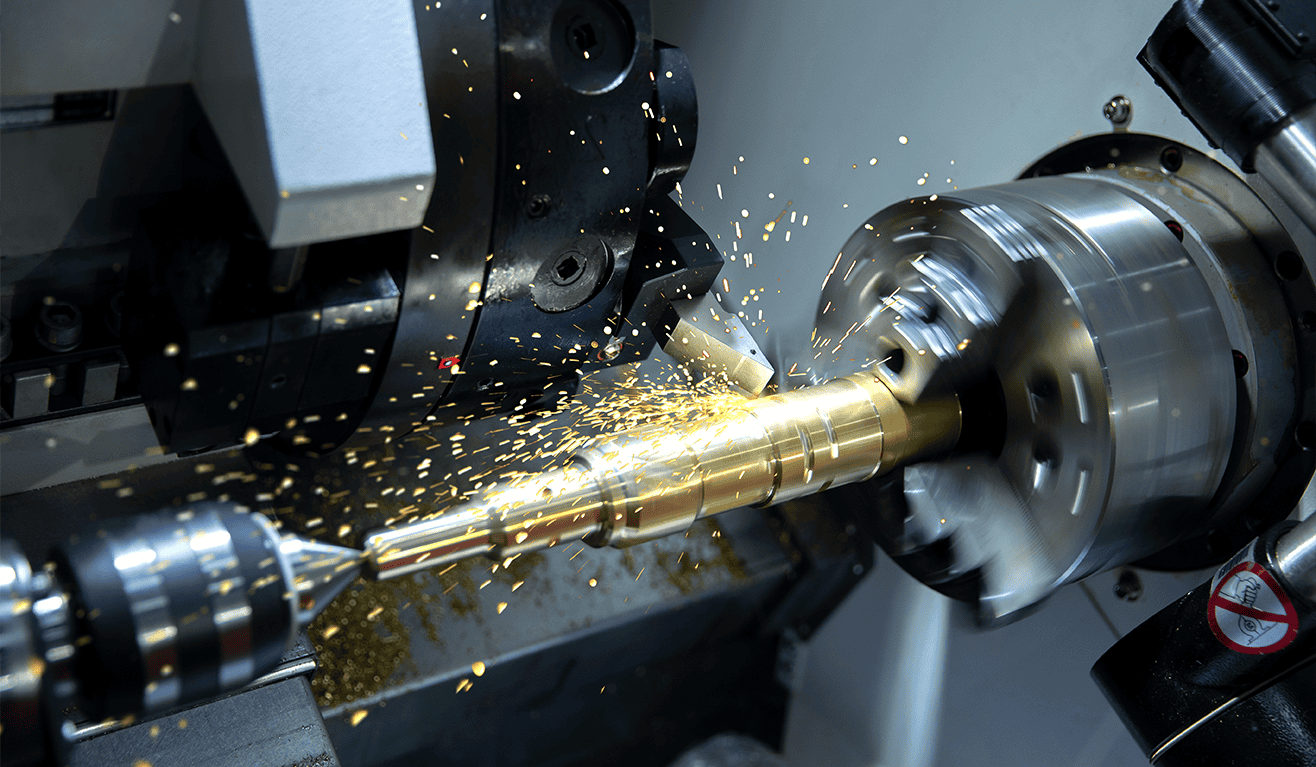
Custom CNC Turning Services

Solnit offers advanced CNC turning service and turn-mill machining solutions provide high-precision, cost-effective manufacturing for custom CNC turning parts. From prototyping to volume production, our CNC turned parts deliver exceptional durability, accuracy, and repeatability.

Request a Rapid Quote
cnc_turning

CNC Turning Capabilities

Solnit’s CNC turning services utilize advanced lathes and centers for high precision, efficiency, and flexibility in various geometries and volumes. We run horizontal and vertical CNC machines, as well as multi-axis and mill-turn centers to address complex demands.

Standard CNC Turning

Application: High-speed turning of cylindrical parts such as shafts, bushings, housings, flanges, discs, and wheels.

Max Machining Range:

  • Horizontal Lathes: Ø500 mm × 1000 mm
  • Vertical Lathes: Ø1000 mm × 800 mm

Features:

  • High RPM spindles for smooth finishes
  • Gravity-assisted work holding (VTL)
  • Automatic tool changers (ATC)
  • Bar feeders for unattended operation
  • Optional live tooling (VTL)
Multi Axis CNC Turning
Multi-Axis CNC Turning

Application: Complex parts needing turning and secondary milling in a single setup.

Max Machining Range:

  • Diameter: up to Ø400 mm
  • Length: up to 800 mm

Features:

  • Y & C-axis for off-center milling/drilling
  • Sub-spindle for simultaneous machining
  • Reduced setups & improved accuracy
  • Ideal for medium-to-high complexity parts
Mill-Turn Machining
Mill-Turn Machining

Application: Hybrid systems for high-complexity components with rotary & prismatic features.

Max Machining Range:

  • Diameter: up to Ø350 mm
  • Length: up to 600 mm

Features:

  • One-pass production for turned-milled parts
  • High accuracy & reduced lead time
  • Multi-face machining without re-clamping
  • Ideal for aerospace, medical, & custom parts
Swiss-Type Turning
Swiss-Type Turning

Application: Small-diameter, high-precision parts (medical, electronics, aerospace, watches).

Max Machining Range:

  • Diameter: up to Ø32 mm (some up to Ø38 mm)
  • Length: typically up to 400 mm

Features:

  • Sliding headstock with guide bushing
  • Simultaneous multi-tool cutting
  • Tight tolerances (±0.002 mm)
  • Perfect for long, slender parts

Solnit ensures ISO-grade precision and repeatability, from prototypes to full-scale production.

Advantages of CNC Turning

CNC Turning provides numerous benefits, making it ideal for manufacturers seeking to produce high-precision parts quickly and cost-effectively. Solnit specializes in superior CNC turning services, offering efficiency, quality, and versatility across various industries. Solnit ensures that your parts are produced with the highest quality, on time, and within budget. Whether you need complex geometries, high-volume production, or precise, high-quality components, CNC turning is the ideal solution for your manufacturing needs. Top 6 advantages of CNC turning:

Efficiency in Producing Symmetrical Parts

CNC Turning efficiently produces symmetrical, cylindrical parts like shafts, pins, and bushings. The machine automatically rotates the workpiece, ensuring continuous cutting with minimal human intervention, speeding up production for high-volume runs of consistent shapes.

Cost-Effectiveness for Large Batches

CNC Turning provides a cost advantage, especially for high-volume production, due to automated tool changes, part handling, and cutting processes, which lower labor costs and reduce human error. CNC turning machines can operate continuously without operator intervention, making them ideal for cost-effective large-batch production.

Precision and Consistent Quality

CNC Turning excels in producing precise, high-quality parts with tolerances as tight as ±0.005 mm, ensuring consistent accuracy and meeting exact specifications throughout production.

Superior Surface Finish

CNC Turning offers excellent surface finish with little post-processing. High-speed rotation and fine tool feed ensure smooth finish, crucial for aerospace and medical parts where surface integrity is essential.

Versatility in Materials

CNC Turning works with various materials, including metals (aluminum, stainless steel, brass, titanium), plastics (POM, PTFE), and composites, allowing manufacturers to choose the best material for each part's application, ensuring optimal performance and durability.

Reduction in Setup Time and Tool Changes

CNC Turning, with its advanced automation, reduces setup time and tool changeover. It programs multiple operations (turning, drilling, threading) in a single cycle, minimizing downtime and optimizing production efficiency.

CNC Turning Surface Finishing Options

Surface finish is vital for CNC-turned parts’ functionality and aesthetics. Different finishes, like smooth polish or rough texture, improve performance and durability. Common surface finishing options in CNC turning include descriptions and typical applications.

Finishing Option Process Description Typical Applications / Benefits
Standard CNC Turning Finish Basic turning process that leaves a smooth surface with some tool marks. Ideal for parts that do not require a highly polished finish. Used for functional parts such as shafts, brackets, and bushings.
Polishing A mechanical process using abrasive compounds to achieve a high-gloss finish. Used in applications requiring aesthetic appeal, such as medical devices, decorative components, and consumer products.
Anodizing An electrochemical process that increases the thickness of the natural oxide layer on the surface of aluminum. Common in aerospace, automotive, and electronics for corrosion resistance, durability, and aesthetic appeal.
Electroplating A process that uses an electric current to deposit a layer of metal (e.g., nickel, chrome) onto the part surface. Often used for corrosion resistance, wear resistance, or appearance. Common in automotive and electronic industries.
Bead Blasting A blasting process that uses fine beads to create a uniform matte or textured finish. Frequently used in applications where a non-reflective finish is required, such as medical devices, aerospace components, and consumer products.
Sandblasting A surface preparation technique using sand particles at high pressure to clean or texture a surface. Ideal for creating rough textures on parts for better adhesion or appearance. Used in industries like automotive, furniture, and decorative metal works.
Heat Treatment A process of heating and cooling metals to alter their physical properties. Can improve surface hardness. Used for parts requiring increased hardness, strength, and wear resistance, such as gears, shafts, and cutting tools.
Coating (Powder Coating, PVD) Application of a thin, protective coating to enhance durability and aesthetic properties. Used to protect parts from corrosion and wear while providing a durable, high-quality finish. Common in automotive, electronics, and aerospace.

Order Your Custom Parts Today

Get a Rapid Quote